
Custom Software vs Off-the-Shelf Software (2026 Guide): Cost, Scalability & ROI Compared
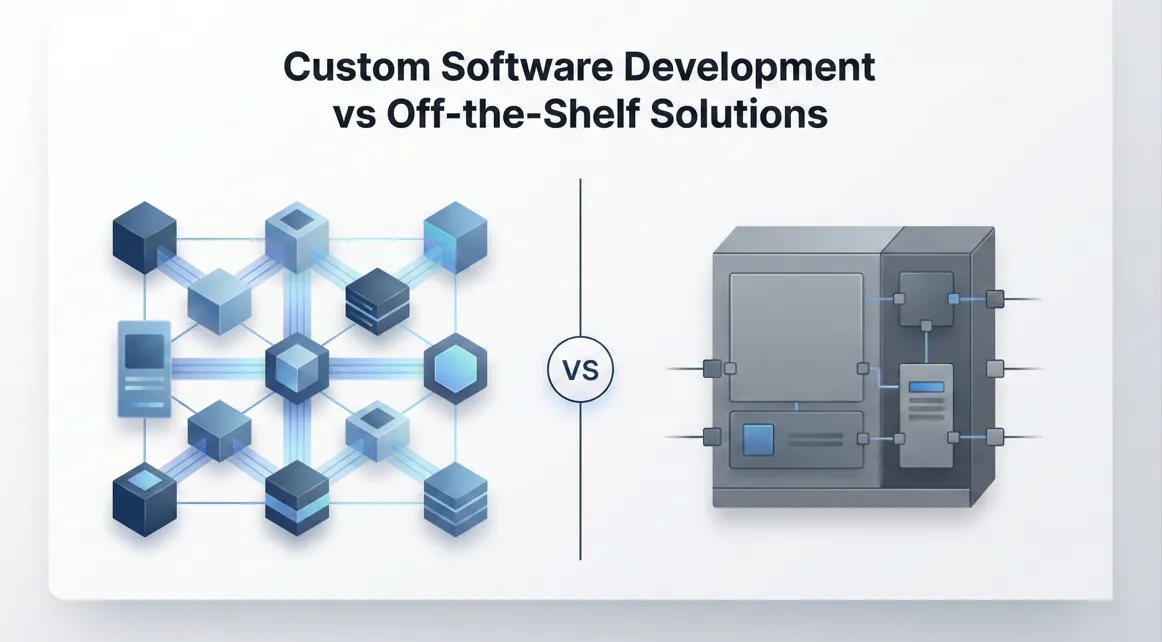
In 2026, businesses face a critical technology decision that echoes far beyond the IT department: Should you invest in custom-built software or rely on off-the-shelf solutions?
This is no longer just a question of budget or timeline. It is a fundamental strategic choice about how your organization typically operates, scales, and differentiates itself in a saturated market. While ready-made tools offer undeniable convenience and speed-to-market, they often come with hidden ceilings—limitations that can restrict scalability, hamper integration, and degrade long-term operational efficiency.
For decision-makers, understanding the nuances between these two paths is essential before committing capital. In this guide, we will dissect the build-vs-buy dilemma, analyzing the long-term ROI, strategic value, and operational impact of each approach.
The Build vs Buy Decision Explained
At its heart, the "build vs. buy" debate is about control vs. convenience.
- Buying (Off-the-Shelf) is like renting a furnished apartment. You can move in immediately, it looks good, and everything works. However, you cannot knock down a wall to make the kitchen bigger, and if the landlord changes the locks (or the pricing model), you have to adapt.
- Building (Custom Software) is like designing and constructing your own home. It takes longer and requires more upfront investment, but every room is purpose-built for how you live. You own the foundation, the structure, and the future value.
In today's digital-first economy, where software is the business, relying solely on rented infrastructure can be a significant risk.
What Is Custom Software Development?
Custom software development refers to the process of designing, building, and deploying software tailored specifically to a specific set of users, functions, or organizations. Unlike commercial off-the-shelf (COTS) software, custom development targets a narrow set of requirements.
Instead of adapting your business workflow to match the rigid logic of a pre-built tool, the system is designed around your unique operations. This approach is often the backbone of distinct competitive advantage.
Benefits of Custom Software
- Full Control & Ownership: You own the code, the data, and the roadmap. You are not beholden to a vendor's feature release schedule or discontinuations.
- Limitless Scalability: As your business grows, the software grows with you. You can build modularly, adding features only when they are needed.
- Seamless Integration: Custom solutions can be architected to fit perfectly into your existing tech stack, communicating effortlessly with legacy systems or third-party APIs.
- Competitive Differentiation: If you buy the same software as your competitors, you have operational parity. If you build unique features that solve customer problems better, you have a market edge.
Strategic Insight: Partnering with a specialized firm for Custom Software Development allows you to leverage expert engineering without diverting focus from your core business activities.
What Is Off-the-Shelf Software (SaaS)?
Off-the-shelf software, often delivered as Software as a Service (SaaS), is a ready-made product designed for mass market use. These solutions aim to solve common problems for a broad audience.
Examples include:
- CRM: Salesforce, HubSpot
- Project Management: Jira, Asana, Monday.com
- Accounting: QuickBooks, Xero
These tools are built on a "one-size-fits-many" philosophy. They are incredibly powerful for standard processes but can become restrictive as edge cases arise.
Pros and Limitations
While fast to deploy, mass-market tools often:
- Include Bloatware: You pay for 100% of the features but may only use 20%.
- Create Vendor Lock-in: Migrating data out of a proprietary ecosystem can be notoriously difficult and expensive.
- Lack Deep Customization: You can often tweak the UI, but you cannot change the underlying logic to suit a unique business process.
Custom vs Off-the-Shelf: Key Differences
To make an informed decision, we need to look beyond the initial price tag and consider the Total Cost of Ownership (TCO) and strategic value over time.
| Capability | Modernsoft Style | Off-the-Shelf | Verdict |
|---|
Scalability and Flexibility
- Custom Software: Built to scale. As your user base expands from 100 to 1 million, the architecture can be optimized specifically for your traffic and data patterns. It adapts to your changing business model.
- Off-the-Shelf: Scalability is defined by the vendor's tier levels. You may hit "feature ceilings" where the software simply cannot support a complex new workflow without a massive enterprise license or clumsy workarounds.
Statistics show that 60% of scaling startups outgrow their initial SaaS stack within 3 years, forcing expensive migrations at critical growth stages.
Cost Dynamics Over Time
- Off-the-Shelf: Lower Upfront, Higher Long-term. The entry cost is low (monthly subscription), but as you add seats and features, the recurring costs balloon. SaaS spending is projected to exceed $300B in 2026, largely driven by enterprise license fees.
- Custom Software: Higher Upfront, Lower Long-term. The initial CAPEX is significant. However, once built, you own it. Ongoing costs are reduced to maintenance and hosting. There are no per-seat licensing fees to eat into your margins as you grow.
Planning a Software Investment in 2026?
Before committing to a platform or vendor, get a technical feasibility assessment from experienced architects.
👉 Book a Free Strategy Call with Modernsoft Innovations
Integration Capabilities

Modern businesses run on data flow.
- Custom systems can be built with an "API-first" mindset, ensuring deep, bidirectional integration with ERPs, payment gateways tailored to your region, and proprietary analytics engines.
- Prebuilt tools offer standard integrations. If you need to connect to a legacy mainframe or a niche industry tool, you might be out of luck—or forced to pay for expensive middleware development.
IP & Ownership
This is often overlooked.
- Custom Software becomes a tangible asset on your balance sheet. It increases the valuation of your company. It is proprietary IP.
- Off-the-Shelf is an expense. It adds no intrinsic asset value to your organization.
When Off-the-Shelf Software Makes Sense
It is important to note that custom development isn't always the right answer. Off-the-shelf solutions are excellent for:
- Early-Stage Startups: When you are just validating an idea or an MVP, speed is everything. Don't reinvent the wheel if you don't know if the car will drive yet.
- Commoditized Operations: Processes like Payroll, HR, and General Accounting are highly regulated and standardized. There is little competitive advantage in building your own accounting tool when QuickBooks exists.
- Temporary Campaigns: Short-term marketing sites or microsites often don't warrant a full custom build.
When Custom Software Is the Smarter Investment
Custom software becomes the strategic choice when:
- You Are Scaling Operations: Standard tools are breaking under the weight of your specific workflows. 73% of enterprises are investing in custom digital platforms (Gartner 2025) to break free from these constraints.
- Unique Value Proposition: Your business model is the technology (e.g., Uber, Airbnb, or a specialized Fintech platform).
- Security & Compliance: You operate in highly regulated industries (Healthcare, Finance) where data sovereignty and specific security protocols are non-negotiable.
- Digital Transformation: You are looking to digitize a manual, complex workflow that no existing software covers adequately.
Case Example: A logistics client recently replaced 4 disconnected SaaS tools with a unified custom platform built by Modernsoft. The result? They eliminated manual data entry errors and reduced operational costs by 32% annually.
Decision Framework: The Build vs. Buy Checklist
Use this checklist to evaluate your next software project.
- Is this function core to our competitive advantage?
- Yes → Build
- No → Buy
- Do we have unique/complex workflows that standard tools don't support?
- Yes → Build
- No → Buy
- Will we need deep integration with legacy or proprietary systems?
- Yes → Build
- No → Buy
- Do we anticipate rapid scaling or pivoting of the business model?
- Yes → Build
- No → Buy
- Is ownership of the data and IP critical for our valuation?
- Yes → Build
- No → Buy
If you answered "Yes" to most of these questions, custom development is likely the more sound strategic investment.
Why Businesses Choose Modernsoft for Custom Software
At Modernsoft Innovations, we help enterprises design scalable digital ecosystems with long-term ROI in mind. We don't just write code; we build assets.
- Enterprise-grade architecture: Systems built to handle millions of users.
- API-first system design: Seamless connectivity with your existing tools.
- Dedicated development teams: Access top-tier talent without the hiring overhead.
- Full IP ownership: You own 100% of the code and intellectual property.
Final Verdict
The real question is not whether custom software is more expensive. The real question is whether your business can afford technological limitations.
If software is central to your growth strategy in 2026, ownership and scalability matter.
If you're evaluating this decision, schedule a structured consultation with our engineering team to map the right approach for your business model.
👉 Talk to a Solution Architect
Frequently Asked Questions
Is custom software more expensive than SaaS? In the short term, yes. However, over 3–5 years, custom solutions often become more cost-efficient due to the elimination of recurring license fees and improved operational efficiency.
Can small businesses benefit from custom software? Yes, especially if their operations are unique or require specialized integration. Small businesses often build micro-apps to automate specific workflows that generic tools can't handle.
What industries benefit most from custom software? Finance, healthcare, logistics, SaaS platforms, online marketplaces, and high-growth startups benefit most due to their need for security, compliance, and unique functionality.
Build something great
Ready to scale your next project with an engineering-first team?
Start Your Project