

AI Is Redefining Value in Tech: A Founder’s Perspective
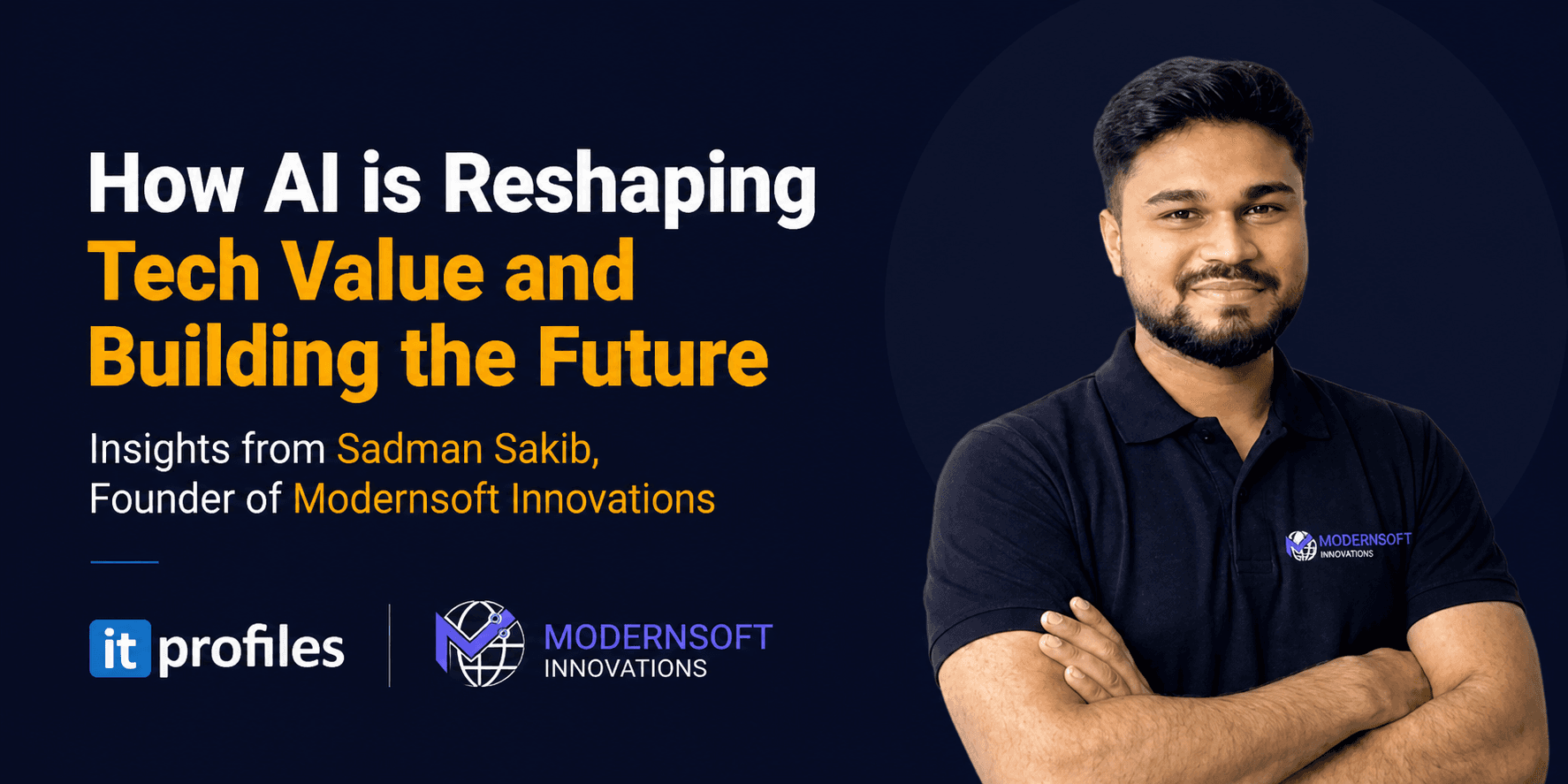
In an exclusive conversation with ITProfiles, Sadman Sakib, Founder of Modernsoft Innovations, shares a grounded perspective on how artificial intelligence is reshaping the expectations clients bring into software engagements today. As more businesses experiment with low-cost AI tools before reaching out to agencies, the starting point of conversations has shifted from "what can be built" to "what should actually be built."
He explains that while this growing awareness is a positive signal, it often comes with oversimplified assumptions about how software works in real-world environments. Clients may see fast outputs, but they do not always see the underlying complexity, trade-offs, and system dependencies that define whether a product truly works at scale.
Through this discussion, Sadman outlines how human-led thinking, system-level understanding, and contextual decision-making are becoming the real differentiators. The conversation highlights a clear pattern: in an AI-driven landscape, the advantage no longer comes from execution alone, but from the depth of understanding behind it.
Why smart clients still choose human teams over $20 AI tools
Sadman Sakib frames this shift in a way that cuts through the noise: AI executes, but humans decide. Smart clients are no longer paying for raw output; they are investing in judgment, context, and accountability. The real value lies in connecting fragmented business realities with technical decisions that actually hold up in production.
Because software is rarely just about building features, it is about navigating messy systems, undocumented dependencies, and long-standing operational quirks. A low-cost AI tool might generate something functional, but it cannot interpret business risk or anticipate how decisions today affect scalability tomorrow.
As he puts it, "A $20 tool can generate code, it cannot understand that your client's inventory system needs to integrate with their 15-year-old accounting software that nobody documented." That missing layer of context often determines whether a product survives beyond launch or quietly breaks under real-world pressure.
At Modernsoft Innovations, the process starts differently by design. The first phase is not about building but about understanding, digging into workflows, constraints, and business logic before a single line of code is written. This is where technical intelligence shows up, turning vague requirements into systems that actually work in practice, not just in theory.
What AI-only projects often fail to handle in real business scenarios
Sakib has seen this pattern play out in very real terms. A garments business approached the team after attempting to run operations on a no-code, AI-driven setup that worked fine on the surface but broke the moment complexity entered the picture.
The system could manage basic billing, but as soon as the business needed godown-to-store stock transfers combined with production cost tracking, it collapsed. These are not edge cases for the business, they are core workflows that define how it actually runs day to day.
As the founder explains, "The tool handled simple billing - but the moment they needed godown-to-store stock transfers with production cost tracking, it collapsed." The limitation was not just technical, it was contextual, the inability to map real operational flow.
They are now building a proper ERP tailored to those workflows, grounded in how the business actually operates. The takeaway is simple: AI tools solve generic problems, but real businesses rarely operate in generic ways, and that gap is where human-led system thinking becomes essential.
How human empathy keeps clients steady when projects hit a wall
He approaches high-pressure moments with a simple principle: communication over silence. When something breaks late at night before a critical demo, the instinct is not to hide behind updates but to reach out directly and take control of the narrative.
Instead of sending a vague status message, Sakib calls and explains exactly what went wrong, what is being done, and when it will be resolved. That level of clarity reduces uncertainty and builds trust in real time, especially when stakes are high.
As he puts it, "When something breaks at 11pm before a client demo, I do not send a status update. I call." The difference lies in how problems are handled, not just how quickly they are fixed.
Empathy in this context is not softness, it is precision in communication. The founder emphasizes that clients rarely panic because of bugs; they panic when they feel uninformed, and closing that gap is what sustains trust.
Why "100% human strategy" is emerging as a new trust signal in tech
Sadman sees a clear shift in how quality is being perceived in modern software projects. What "organic" or "handmade" signals in other industries, human-led strategy is beginning to represent in tech, something thoughtful, accountable, and intentionally crafted rather than mass-produced output.
Clients are increasingly aware that automated tools can generate results, but they cannot take responsibility for outcomes. That distinction matters more in systems where decisions have long-term business impact, not just immediate functional value.
As he puts it, "Just like 'organic' in food, 'human-led strategy' in tech signals accountability, deeper thinking, and responsibility for outcomes, not just automated output." This framing positions human involvement not as a cost, but as a quality layer.
The founder emphasizes that in mission-critical systems, clients are not buying code, they are buying confidence. And that confidence comes from knowing someone is thinking through the consequences, not just generating solutions.
The one human skill that will define irreplaceability in the next year
Sadman points to a skill that sits above tools, stacks, and even execution speed: problem framing. While most conversations revolve around coding efficiency or Artificial Intelligence adoption, he believes the real leverage lies in defining the right problem before anything gets built.
Because once the problem is framed correctly, everything else, tools, teams, and even AI, can align and accelerate toward the right outcome. But if that initial framing is flawed, speed becomes a liability, not an advantage.
As he puts it, "If you define the problem correctly, AI becomes an accelerator. If you define it wrong, AI just scales the mistake faster." That distinction is what separates thoughtful systems from expensive misfires.
The founder emphasizes that problem framing is not a technical step, it is a thinking discipline rooted in understanding business context, constraints, and intent. It is this layer that ensures technology serves the right purpose, not just executes efficiently.
How to stay human and trustworthy in an AI-saturated content landscape
Sadman approaches this challenge by rejecting the idea that polish equals credibility. In a space where everyone can generate clean, structured, and "perfect" content, what stands out is not refinement but specificity.
Instead of broad claims or generic insights, he anchors communication in actual experience, real systems, real constraints, and real outcomes. This makes the narrative feel grounded in business logic rather than manufactured tone.
As he puts it, "Instead of sounding 'perfect,' we sound precise and grounded in actual business logic." That precision creates a different kind of trust, one that comes from relevance rather than presentation.
The founder emphasizes that people are no longer convinced by flawless language alone. They are looking for clarity, context, and signals of lived experience, and that is what makes a brand feel like someone worth talking to.
What bots will never fully understand about real-world systems
Sadman points to something most clean demos never reveal: the operational chaos behind real systems. On paper, workflows look structured and predictable, but in practice, they are constantly shifting based on people, constraints, and evolving priorities.
In real businesses, requirements change mid-way, users behave unpredictably, and decisions rarely follow a straight line. What starts as a clear plan often turns into a series of trade-offs that need to be evaluated in context.
As he puts it, "AI understands patterns, but not messy reality where trade-offs constantly shift." That gap becomes critical when systems need to adapt in real time, not just follow predefined rules.
The founder emphasizes that this unpredictability is not an exception, it is the norm. Navigating it requires judgment, experience, and the ability to balance competing priorities.
Why founder instinct still outpaces data in critical moments
Sadman draws a clear line between what data can show and what instinct can interpret. Data is excellent at revealing patterns and past behavior, but it stops short of explaining intent or emotion.
In day-to-day interactions, signals are rarely explicit. A client going quiet after a demo could mean many things, but reading between the lines requires experience, not just analysis.
As he puts it, "Data tells you what happened. Instinct tells you what it means." That distinction shapes how conversations evolve, how risks are assessed, and how decisions are made under uncertainty.
He acknowledges that instinct is not perfect and has its misses, but over time it sharpens through exposure to real scenarios. The founder emphasizes that this accumulated judgment often outperforms pattern-matching models.
Why human-led strategy is becoming a premium layer in modern tech delivery
Sadman sees this as a natural shift driven by how accessible execution has become. When anyone can generate a functional website or app in minutes, the baseline for delivery drops significantly.
Because of that, the real product is no longer the build itself, but the thinking behind it. Clients are starting to recognize that speed without direction leads to shallow outcomes.
As he puts it, "They are not just buying code anymore. They are buying someone who will tell them when their idea needs to change." That shift reflects a deeper need for honesty and guidance.
The founder emphasizes that this advisory layer is what clients are truly investing in. After experiencing the limits of cheap, AI-led work, they value partners who take responsibility for outcomes and challenge assumptions.
Will the future be bot-first, or are we heading back to human-led work?
Sadman does not see this as a swing back to humans, but as a clear split forming across the industry. On one side, commodity work will continue to be automated aggressively, driving prices down.
On the other side, complex and relationship-driven work will move in the opposite direction. Projects that involve ambiguity and high stakes will demand more human involvement.
As he puts it, "Commodity work will be fully automated and the price will drop to near zero. Complex, relationship-dependent, high-stakes work will go the other way, more expensive and more human than ever."
The founder emphasizes that survival depends on moving up the value chain fast enough. Agencies that continue competing on execution alone will struggle, while those that double down on thinking and advisory will define the next phase.
Build something great
Ready to scale your next project with an engineering-first team?
Start Your Project